
The Future of AI in Commercial Aquaculture: From Biological Intelligence to Autonomous Production
07/07/2026
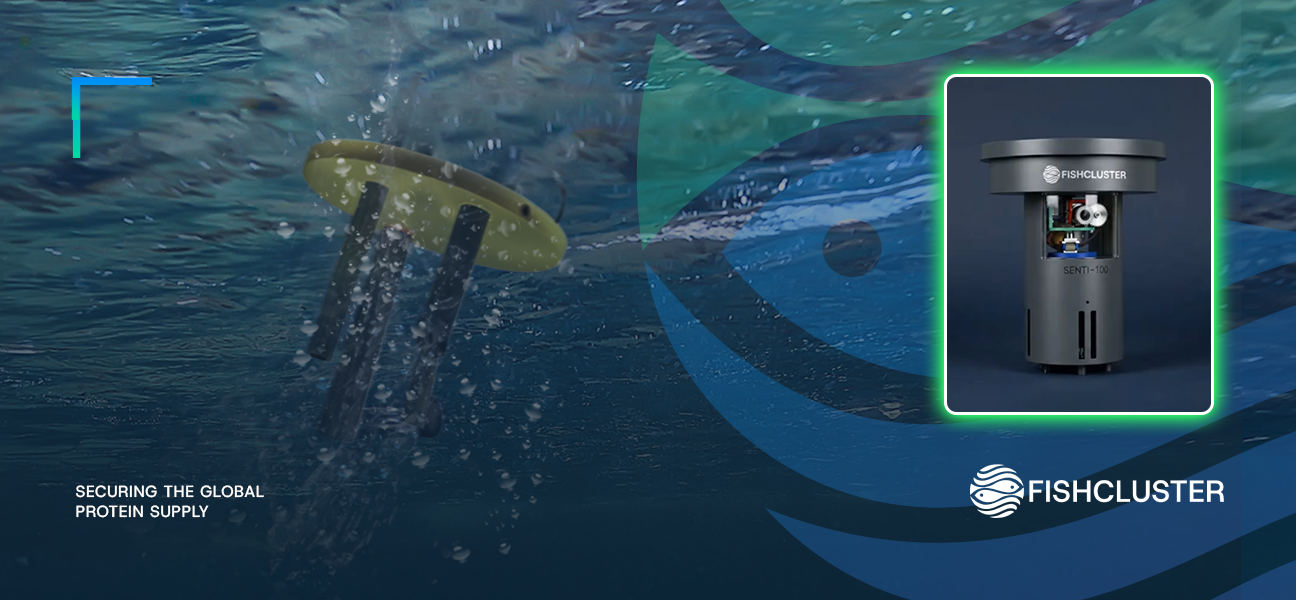
The Invisible World Beneath the Surface
Artificial intelligence has reached a defining moment in its evolution. Over the past decade, AI has transformed industries built around digital information. Large language models, predictive analytics and generative systems have reshaped how people communicate, create, and make decisions. Yet much of the physical world continues to operate through manual observation, periodic inspection and human intuition. Nowhere is this more evident than in commercial aquaculture. Despite being the fastest-growing food production sector in the world, commercial fish farming remains one of the least digitized industries. Beneath the surface of every pond exists a living biological system that is constantly changing, yet much of that change remains invisible. The next era of artificial intelligence will not be defined solely by software running in the cloud. It will be defined by intelligent systems capable of understanding and responding to the physical world in real time. That future begins beneath the surface of the water.
Artificial intelligence is often discussed as though algorithms are the industry's greatest challenge. They are not. Artificial intelligence has never lacked algorithms, it has lacked continuous, high-quality biological data. Every successful AI system begins with observation. Financial AI learns from transactions. Medical AI learns from clinical data. Autonomous vehicles learn from cameras, sensors and road conditions. Commercial aquaculture has historically generated very little continuous observational data from the production environment. The limitation has never been intelligence, it has been visibility.
Commercial aquaculture is, in many ways a living factory. Modern manufacturing facilities operate with continuous awareness. Sensors monitor production in real time, detect abnormalities before failures occur and provide operators with immediate visibility into the production environment. Commercial aquaculture operates very differently. Fish behave beneath opaque water. Environmental conditions change continuously. Biological responses evolve every second. Yet much of this activity remains invisible until productivity has already been affected. The challenge is not a lack of experience, it is a lack of continuous observation.
Fish farming is fundamentally a biological production system. Every movement, behavioural pattern, feeding response and environmental interaction contains information. Swimming behaviour reflects metabolic activity. Feeding patterns reveal appetite. Water chemistry influences growth and survival. Environmental conditions shape productivity long before they become visible to the human eye. Biology is constantly generating data. For generations, much of that data has remained inaccessible. The future of commercial aquaculture depends on making invisible biology measurable.
From Observation to Autonomous Decisions
Continuous observation changes everything. Autonomous underwater systems equipped with advanced sensors, computer vision, and edge computing create a continuous stream of biological information directly from the production environment. Rather than relying on periodic inspections or manual observation, commercial farms gain continuous visibility into the biological systems they manage. This is where artificial intelligence begins creating value. Artificial intelligence is not another software application. It is the decision layer that transforms biological observations into operational intelligence. Observation becomes understanding. Understanding becomes prediction. Prediction becomes better decisions.
One of the greatest opportunities for artificial intelligence in commercial aquaculture lies in feed optimization. Feed represents the largest operating expense for most commercial fish farms, routinely accounting for 70 percent of total operating costs. Yet feeding decisions are still frequently based on fixed schedules, periodic observation, and human judgment. Even small inefficiencies, repeated throughout a production cycle, can result in significant financial losses while negatively affecting water quality and fish health.
Artificial intelligence enables a fundamentally different approach. By continuously interpreting biological signals such as swimming behaviour, feeding responses, schooling patterns and environmental conditions; intelligent systems can estimate appetite, detect behavioural changes and optimize feeding decisions in real time. Rather than reacting after waste has already occurred, farms gain the ability to continuously optimize production before inefficiencies become losses. The result is more than reduced feed costs. It is healthier ponds, stronger biological performance, greater production consistency, and more resilient commercial operations.
Artificial intelligence becomes even more valuable when individual observations are connected together. Behaviour. Water quality. Environmental conditions. Historical production records. Operational performance. Together, these create predictive intelligence. Instead of waiting for operational problems to emerge, commercial operators can identify risks earlier, respond with greater precision, and make decisions based on probabilities rather than assumptions. Artificial intelligence shifts commercial aquaculture from reactive management to predictive operations. That transition fundamentally changes productivity.
Building the Connected Aquaculture Network
The value of biological intelligence extends far beyond individual farms. When biological and operational data become continuously measurable, the benefits compound across the entire aquaculture value chain. Financial institutions gain greater confidence in evaluating agricultural risk through objective production data rather than limited historical records alone. Feed manufacturers develop better visibility into consumption patterns and production cycles. Processors benefit from more predictable harvest volumes. Retailers gain greater confidence in future supply. Insurance providers can assess biological and operational risks with greater precision. Artificial intelligence therefore becomes more than a farm management tool. It becomes infrastructure for an entire industry.
As more commercial farms become connected through intelligent infrastructure, aquaculture begins to evolve into something entirely new. Individual ponds no longer operate as isolated production environments. Instead, they become part of an interconnected network that continuously learns from millions of biological observations collected across diverse environments. Every production cycle strengthens the collective intelligence of the network. Every connected pond contributes new biological knowledge. Every new observation improves future decision-making. Artificial intelligence becomes more capable because the ecosystem itself becomes more connected. This is the beginning of digital aquaculture.
Looking further ahead, intelligent aquaculture networks have the potential to enable an entirely new level of coordination across the industry. Production forecasts become more accurate. Supply chains become more predictable. Financial institutions gain greater confidence in deploying capital. Commercial operators can make better long-term decisions based on continuously improving biological intelligence. This is not simply the digital transformation of fish farming. It is the emergence of a connected operating system for commercial aquaculture.
Artificial intelligence will not transform commercial aquaculture simply because algorithms become more powerful. It will transform commercial aquaculture because humanity is finally gaining the ability to continuously understand biological systems that were previously invisible. At Fishcluster, we believe biology, robotics, artificial intelligence, and intelligent infrastructure are not independent technologies. They are complementary layers of a single operating system for commercial aquaculture:
- Biology generates the signals.
- Robotics captures the signals.
- Artificial Intelligence interprets the signals.
- Infrastructure enables those insights to scale.
Together, they make invisible biology visible, transform uncertainty into intelligence, and enable a more resilient global food system. We believe that is how the future of commercial aquaculture will be built. And we believe that future has already begun beneath the surface of the water. That is the future we are building toward.