
Why Fish Farmers Need Better Infrastructure, Not More Apps
07/03/2026
The App Fatigue & The Sub-Surface Blindspot
Over the past two decades, agriculture has experienced an unprecedented wave of digital innovation. Thousands of software applications have been developed to help farmers record expenses, monitor prices, access financing, connect with buyers, manage inventory, and improve day-to-day operations. These tools have introduced new levels of convenience across many agricultural value chains.
Yet despite this rapid expansion of agricultural software, many of the structural challenges facing commercial aquaculture remain fundamentally unchanged. Production losses remain high, feed continues to represent the single largest operating expense for commercial farms, biological risks remain difficult to detect early, access to affordable financing remains limited, and supply chains remain fragmented.
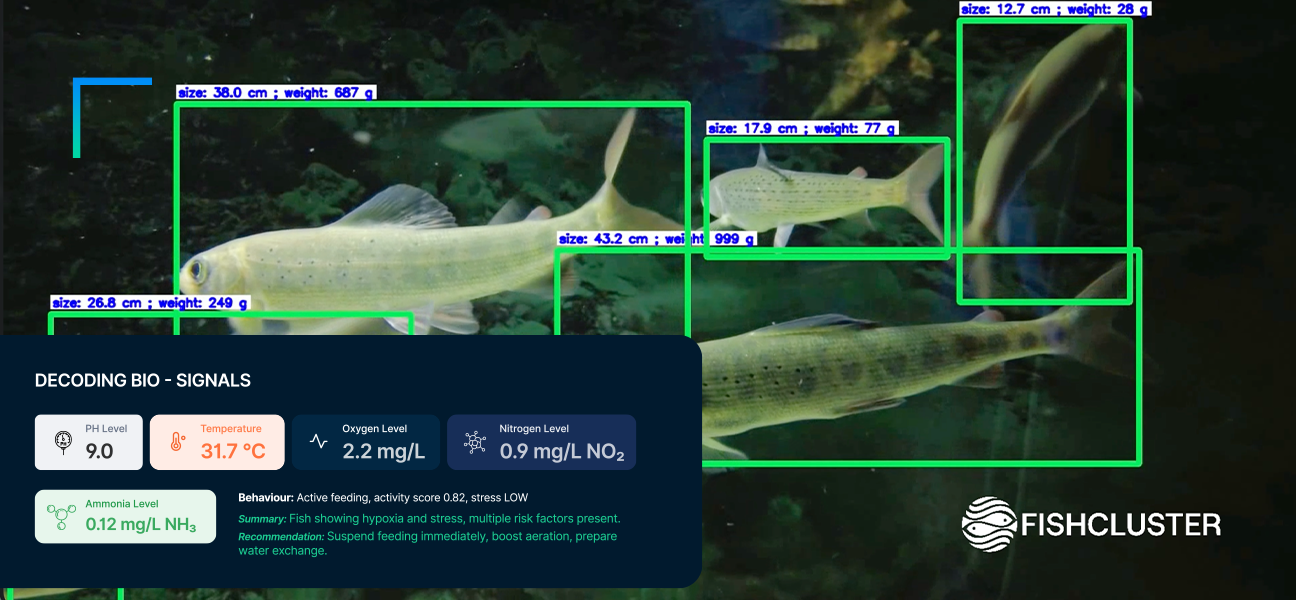
The problem is not a lack of software. The problem is that software alone cannot solve physical problems. A mobile application cannot see beneath the surface of opaque water. It cannot detect changes in dissolved oxygen before fish become distressed, it cannot continuously observe fish behaviour, it cannot autonomously optimize feeding and it cannot prevent biological losses before they occur.
Commercial aquaculture does not primarily suffer from an information-sharing problem; it suffers from an infrastructure problem. Fish farmers do not need another dashboard to manually record what has already happened. They need intelligent infrastructure capable of preventing losses before they materialize.
Commercial aquaculture is fundamentally different from most agricultural industries. Crop farmers can visually inspect leaves. Livestock producers can continuously observe animal behaviour. Fish farmers manage biological systems that remain hidden beneath the surface of the water. Much of what determines productivity happens where human observation is naturally limited. Changes in dissolved oxygen, water chemistry, feeding behaviour, stress responses, appetite and growth continuously influence farm performance long before they become visible to the human eye.
This is where software reaches its natural limit. Most software applications depend on manual observation. Someone must first notice a problem, interpret it correctly, and record it. Only then can software respond. By that point, valuable production time and often biological performance has already been lost. Manual data entry is retrospective. Commercial aquaculture requires continuous observation. That distinction changes everything.
Macro Economics & Infrastructure-Driven Intelligence
To fully contextualize why software-only applications fail, one must examine the actual scale and demographic architecture of African aquaculture. According to the Food and Agriculture Organization (FAO), Africa accounts for approximately 2.6 percent of global aquaculture production, yielding roughly 2.32 million metric tons annually. However, this production is heavily concentrated. The top five aquaculture nations on the continent represent over 95 percent of Africa's entire output, yet they are governed by wildly distinct demographic and structural profiles.
Although Africa currently contributes only a small share of global aquaculture production, its commercial production is concentrated across a handful of countries including Egypt, Nigeria, Uganda, Ghana and Zambia; each with distinct production systems and operating environments. Despite these differences, they all share one structural constraint - fish farming remains an invisible production system.
Across all five of these macroeconomic pillars, whether managing an intensive concrete tank in Lagos, a floating cage in Lake Volta, or an earthen pond in the Nile Delta, manual data collection fails because it cannot bypass the water barrier. The future of commercial aquaculture will not be built around manual data collection; it will be built around continuous biological intelligence.
Autonomous underwater systems equipped with sensors, computer vision, and edge computing can continuously observe the production environment, capturing biological and environmental information directly at its source. Rather than waiting for operators to report what has already happened, intelligent infrastructure continuously measures what is happening now. Artificial intelligence then transforms those biological observations into operational intelligence. Observation becomes understanding. Understanding becomes prediction. Prediction becomes better decisions. This is the difference between software and infrastructure: software organizes information; infrastructure creates intelligence. That distinction will define the next generation of commercial aquaculture.
The economic implications are significant. Feed typically represents between 70 percent of a commercial fish farm's operating expenses. Yet feeding decisions are still frequently based on fixed schedules, periodic observation, and human judgment. Due to these imprecise, intuition-based manual feeding methods, up to 30% of that expensive input sinks to the bottom of the pond completely unconsumed to rot, rapidly toxicifying the aquatic environment through ammonia spikes. Even small inefficiencies, repeated throughout a production cycle, can significantly reduce profitability while negatively affecting water quality and fish health.
Intelligent infrastructure enables a fundamentally different operating model. By continuously interpreting biological signals, including fish behaviour and environmental conditions, farms can optimize feeding decisions before inefficiencies become losses. Production becomes more predictable, feed efficiency improves, biological risk is reduced, and operational consistency increases. Infrastructure does not simply improve workflows; it fundamentally changes the economics of commercial aquaculture.
The Connected Industry Network Moat
Applications create value for individual users. Infrastructure creates value for entire networks. Every additional pond connected to an intelligent operating system strengthens every other connected pond. Every production cycle contributes new biological intelligence. Every operational outcome improves future prediction. Every deployment expands the industry's collective understanding.
Infrastructure becomes more valuable as adoption grows. Applications rarely behave this way. This compounding effect is what transforms industries not because individual tools become more powerful, but because the network itself becomes more intelligent over time.
The value of infrastructure extends far beyond individual farms. It reaches every participant in the food system. Continuous biological intelligence enables financial institutions to evaluate agricultural risk with greater confidence. Feed manufacturers gain better visibility into demand. Processors improve production planning. Retailers benefit from more predictable supply. Insurance providers develop more accurate risk models. Operational intelligence begins flowing across the entire value chain rather than remaining trapped within individual farms.
This is the beginning of a connected aquaculture ecosystem. Infrastructure enables biology, robotics, artificial intelligence, finance, and commercial operations to function as one coordinated system rather than disconnected activities. Industries are rarely transformed by software alone; they are transformed by the infrastructure that connects them.
Commercial aquaculture will play an increasingly important role in feeding a growing world. Meeting that responsibility requires more than better software. It requires intelligent infrastructure capable of continuously understanding biology, enabling better decisions, connecting value chains, and supporting more resilient food systems. At Fishcluster, we believe the future of commercial aquaculture will not be built by the next mobile application. It will be built by intelligent infrastructure that transforms biology into intelligence, intelligence into decisions and decisions into sustainable growth. Because software improves workflows, infrastructure transforms industries and we believe that transformation begins beneath the surface of the water.